
The Road Signs We Were Never Given
The signs are there. Most of us were never taught how to read them.

[Concept = human. Image generated with AI.]
The first time I experienced a hairpin turn, I was 11.
My family was on our semi-cross-country road trip, driving through the Blue Ridge Mountains somewhere in North Carolina. My dad announced to my brother and me that the road ahead would be quite twisty and turny and we might want to pay attention to the road signs.
[Side note, I am so grateful every day that I grew up in an era before screens. Yes, I was exposed to television and consumed way too much Gilligan’s Island and The Brady Bunch, but that’s beside the point. I can’t imagine how much I would have missed had I had my face buried in a screen the way so many do these days.]
Dad announced when the hairpin turn was coming. It was the first one of the trip. The first one of my life.
And I was mesmerized.
That yellow warning sign—hairpin turn ahead—anchored something in me I couldn’t name as an 11-year-old. And all these decades later, I still can’t quite name it.
Recognition of forces beyond me, maybe.
The splendor of geography. The understanding that human beings built that road through the mountains and designed that turn so that people like me and my family could move through that terrain.
The work I’m doing now is predicated on reading terrain. On building maps. On being the cartographer of your life.
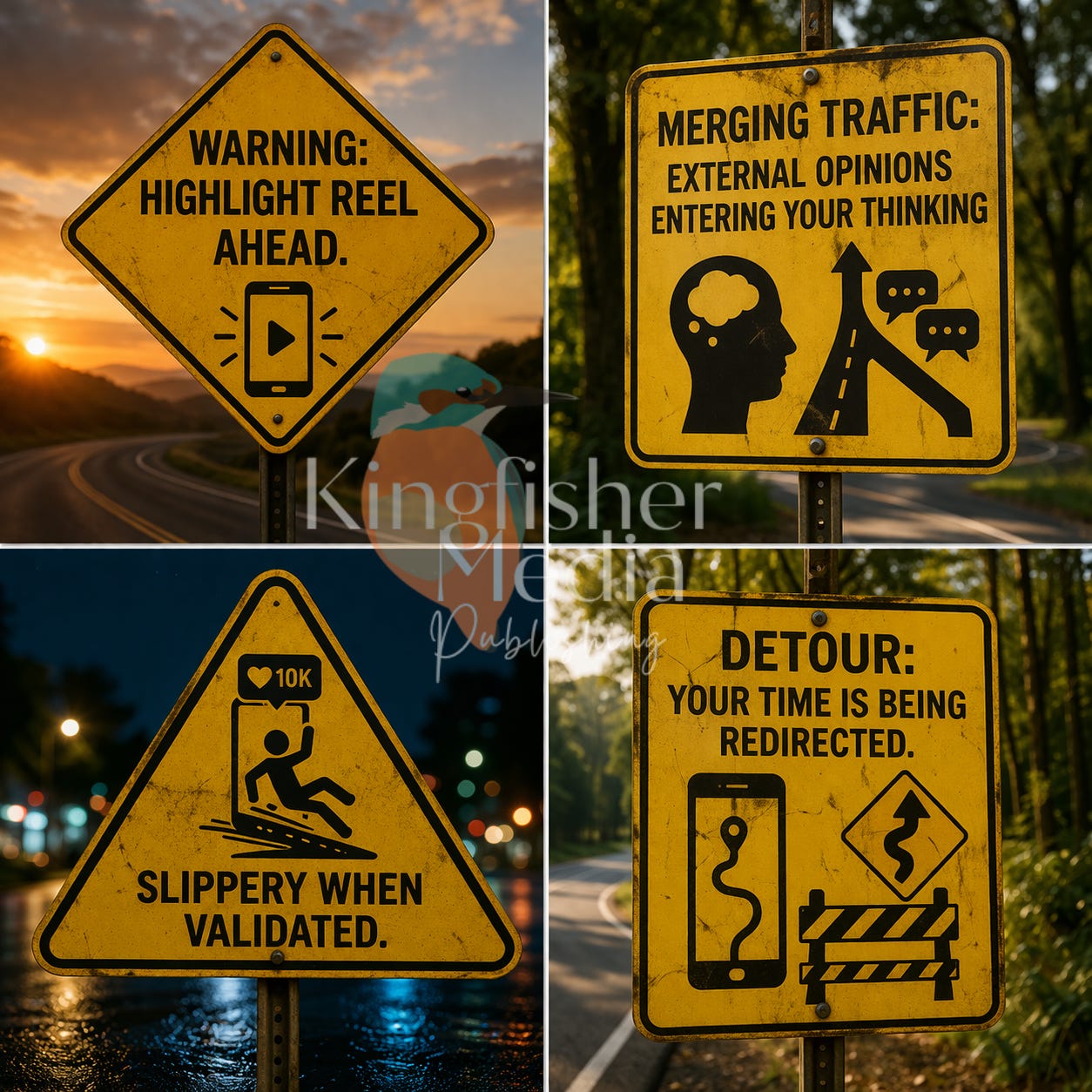
And because I think in visuals, I wanted to create a handful of road signs for algorithmic terrain.
Here are some of those signs.
WARNING: HIGHLIGHT REEL AHEAD
This one is arguably the most important.
I’m not sure there’s anything in the last 15 years that has done more background damage to our collective mental health than the highlight reel.
I’m guilty of posting highlight reels. I posted one just the other day on Instagram.
I didn’t do it to brag. I did it as a way of communicating an idea about my work and my life.
Because one of the navigation skills of living in an algorithmic world is breadcrumbing—leaving marks along the way that add up to who you are, how you serve, what problems you solve.
It took me a little longer to catch on to this.
So yes, there’s an irony here.
I play the algorithm game while also writing a book that, in some ways, critiques the algorithmic environment. Not in a destructive way. More in a way of saying:
You didn’t design this system.
You didn’t ask to live with a smartphone in your pocket.
You didn’t ask for highlight reels.
And yet here we are.
What makes the highlight reel especially tricky is that it doesn’t look dangerous.
Research continues to show that constant exposure to curated, idealized content is associated with increased social comparison, lower self-esteem, and higher levels of anxiety and depressive symptoms, especially when people are passively scrolling and comparing themselves to what they see. The effect isn’t universal, and it’s not purely causal, but it’s consistent enough to matter.
In plain terms: when you repeatedly consume a filtered version of other people’s lives and treat it as a fair comparison set, something in you starts to shift.
For some people, it barely registers.
For others, it erodes their sense of self one scroll at a time.
DETOUR: YOUR TIME IS BEING REDIRECTED
You opened your phone for one thing.
One.
Now you’re ten-twenty-thirty minutes deep in something you didn’t choose, headed somewhere you didn’t intend to go.
No alarm. No friction. Just a whisper of a reroute.
You aren’t flawed and nothing is wrong with your character.
This is design at work the way it was intended.
And again, you didn’t ask for it.
MERGING TRAFFIC: EXTERNAL OPINIONS ENTERING YOUR THINKING
You had a thought. A feeling. A direction.
Then you scroll.
And suddenly, without realizing it, you’re adjusting mid-thought.
Not because you examined your idea, but because you absorbed someone else’s.
SLIPPERY WHEN VALIDATED
This is the one almost no one talks about.
You get a hit—likes, comments, traction—and your footing feels stronger. Who doesn’t like seeing the little hearts floating up over your latest reel?
But it’s actually easier to lose yourself here because now you’re not just expressing, you’re calibrating.
And the road bends without you realizing it.
BLIND SPOT: YOU CAN’T SEE WHAT’S SHAPING YOU
Not everything influencing you is visible.
What you don’t see—what isn’t shown, what’s filtered out—matters just as much as what is.
A recent New York Times article focuses on some young people—Gen Z and below—who are consciously choosing not to use smartphones. My son is among that group, although he was not featured in the article.
These are the kids who were raised on them.
I predicted a while back—take that for what it’s worth—that an entire generation would wake up one day and say, what the f#ck just happened to my childhood?
We’re beginning to see rumblings of that now.
Young people are angry. And they have a right to be.
Because they didn’t ask for this.
It was handed to them.
And who handed it to them?
We did.
We did.
This is on all of us.
Whether you like to hear that or not, that is the truth.
We are all participating in a system we did not design.
And the only way forward—the first step—is awareness.
A deeper awareness of how enmeshed our lives are with these systems.
Because the signs are there.
They’re just not posted on the side of the road the way they were in the Blue Ridge Mountains.
This requires a new way of seeing.
A new way of thinking.
And eventually, a new set of navigation skills.
It’s one of the reasons I created my Algorithmic Drift Diagnostic.
You can learn more about that here.
And I encourage you to consider doing it. Not just for yourself, but for your children, your grandchildren, future generations, the people you care about.
So many people say they want a better world.
But the better world begins here. Today.
Inside this terrain.
The one that isn’t going away.
And if you’re reading this, you’re in it.
Because people who have actively removed themselves from digital terrain—they’re not here. They’re not reading essays like this. They’re not asking these questions.
They’ve already made a decision.
I respect that.
I respect people who make conscious, intentional decisions about their lives versus being carried by a current, shrugging their shoulders, saying, “This is just how it is now.”
It’s not only possible to steer your raft in these currents.
It’s possible to navigate them well.
To use them.
To make something meaningful for your life and for others.
Back in the Blue Ridge Mountains, my dad told us when the turn was coming.
Now no one does.
You either learn to read the road…or you feel it when it’s too late.
Take a look at the Algorithmic Drift Diagnostic.
If it’s right for you, I look forward to serving you in that way.
It’s made a difference in my life.
I think it can in yours too.