
Trying on a Rolex
What an afternoon in an estate jewelry store revealed about identity, inheritance, and invisible currents.

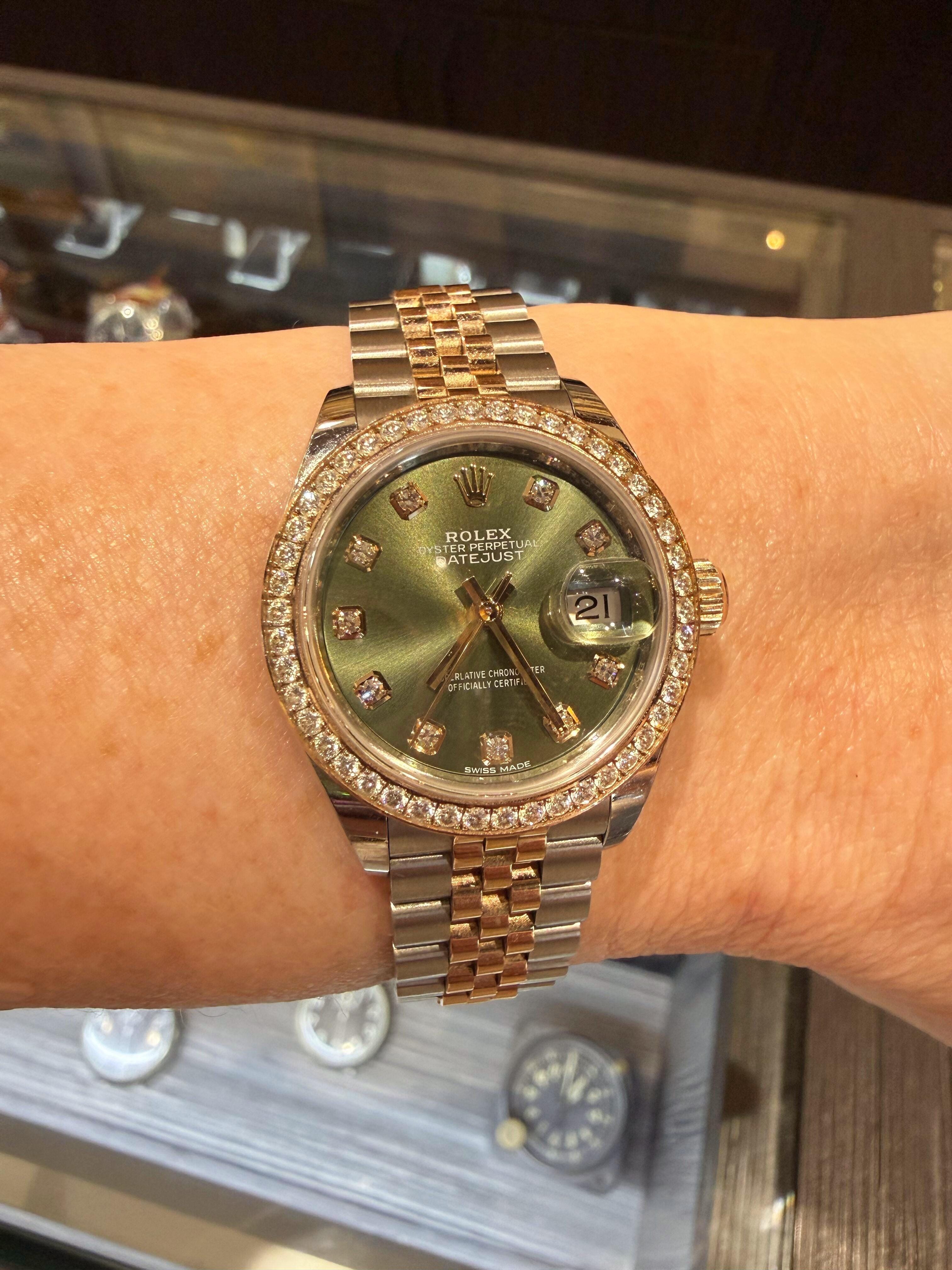
Over the weekend, my best friend took me into an estate jewelry store in Orange, California. She knows the owner and wanted to see his latest vintage Rolex acquisitions.
I had no intention of trying one on. In fact, I’ve never considered myself a Rolex person.
She pointed to a couple of watches in the case, and he carefully laid them on the green velvet pad jewelers use, complete with the little Rolex crown stamped into the fabric.
One was a vintage 1970s 18-karat gold piece with an aftermarket diamond bezel. The other was a much newer model with a smaller dial, a rose gold and steel two-tone band, an olive green face, and diamonds circling the bezel (pictured above).
Both were stunning.
After my friend tried them on, I asked if I could.
When I looked down at those watches on my wrist, I thought, Huh. I get it now.
I wasn’t suddenly calculating how to spend $20,000.
What I noticed was something much more interesting.
Somewhere between fastening the clasp and looking down at my wrist, an identity I had never considered suddenly felt possible.
That surprised me.
My dad loved watches.
After his death, I was tasked with cleaning out his study, sorting through the endless folders and notebooks he had assembled over the years. Among them were folders devoted entirely to watches he found beautiful.
My dad dreamed big when it came to a lot of things: sailboats, cars, tools, and watches.
Ironically, the watch he wore every day was a modest Omega with a brown leather band.
But tucked inside those folders were photographs of Patek Philippe, Breitling, and Rolex watches clipped from magazines and printed from the internet.
Standing there in that jewelry store, I found myself wondering how many of our desires actually belong to us and how many arrive through invisible currents we never think to question.
I certainly didn’t wake up on Saturday thinking about Rolex watches.
I wasn’t thinking about six-figure BMWs or designer handbags or luxury brands.
I’ve never been particularly drawn to signaling status through labels.
So what, exactly, was happening?
It wasn’t about the watch.
It was about me.
Could I be a Rolex woman?
More importantly, why had I assumed I wasn’t?
That question reaches far beyond luxury watches.
There are countless assumptions quietly directing our lives.
I’m not wealthy.
I’m not artistic.
I’m not athletic.
I’m not the kind of woman...
I’m not the kind of man...
I’m not someone who...
Every single day those assumptions influence our choices, often without our awareness.
Sometimes all it takes is one unexpected experience to expose them.
As I stood there looking at a secondary-market Rolex on my wrist, I caught a glimpse of someone I hadn’t previously imagined.
Not because of the watch.
Because of the possibility.
Later my friend told me about her real estate manager, a Rolex enthusiast who seems to drive to Beverly Hills every other week to add another watch to his collection.
Then the owner shared the stories behind some of the watches in the cases.
That’s what makes estate jewelry so fascinating.
Every watch has already lived another life.
Every owner believed different things about themselves.
Some dreamed.
Some achieved.
Some inherited.
Some sold.
One of the watches I admired had belonged to a famous Mexican singer. After he was killed, the watch passed to his son. Years later, his son was also shot outside a nightclub in Tijuana, and eventually the watch found its way into that small estate jewelry store in Orange, California.
As someone who loves Jungian archetypes and the humanities, where stories are threaded through history, myth, and symbol, I found that collection of watches almost mythical.
Each one carried more than time.
Each one carried a story.
And that’s the thing about invisible currents.
They rarely announce themselves.
They quietly shape what feels imaginable long before we realize they’re there.
Over the weekend I walked into a jewelry store thinking I was going to watch my best friend try on watches.
Looking back, I think I was trying on a possibility.
Sometimes all it takes to expose one of those invisible currents is fastening the clasp on a watch you never imagined wearing.