
What Are We Calling Ourselves Now
When the tools change faster than the definitions, identity gets harder to pin down

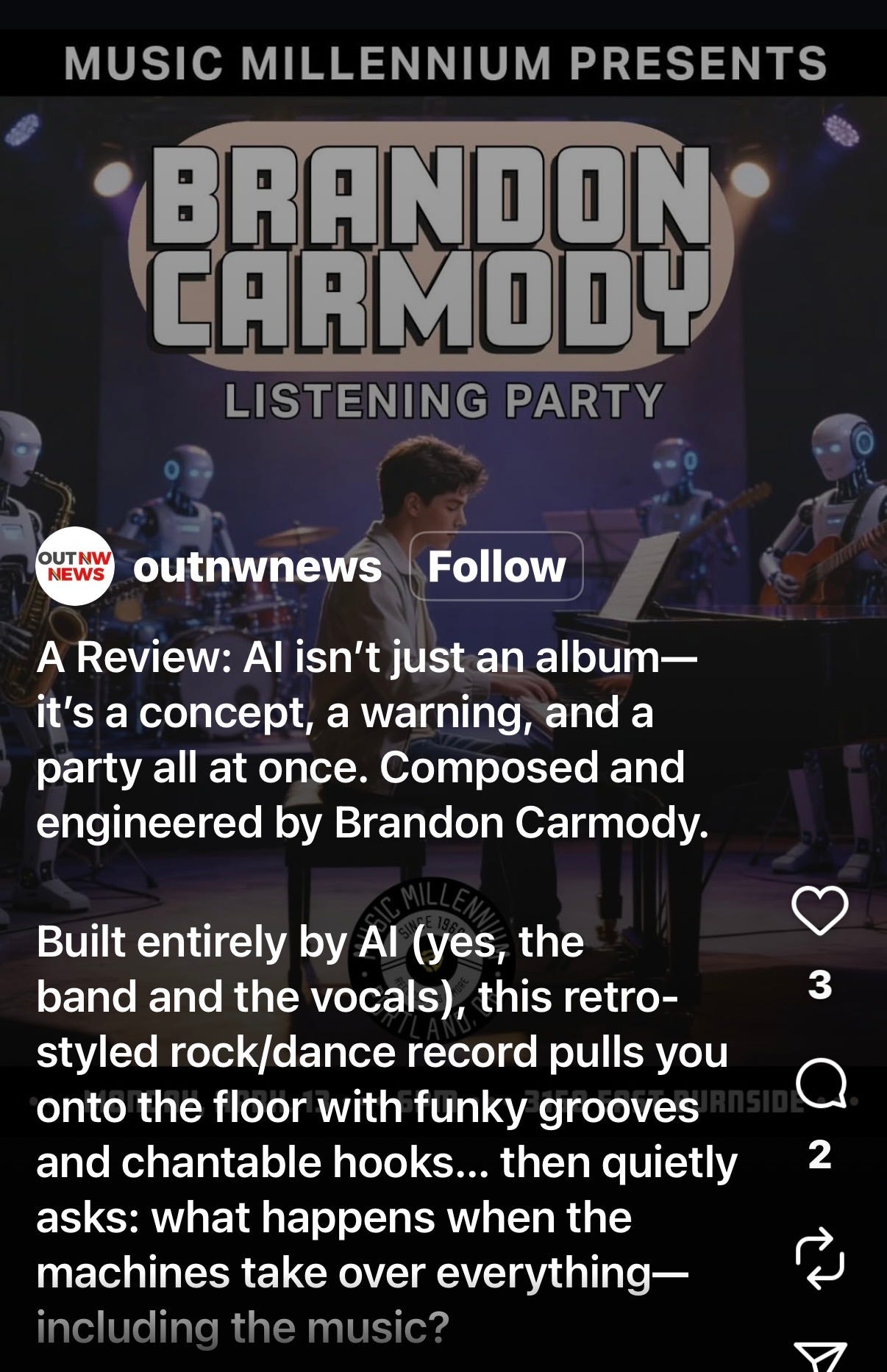
You’ve probably never heard of Brandon Carmody.
I hadn’t either until I read a post on Instagram about him and the controversy surrounding his music which he created with the help of AI.
Brandon Carmody was scheduled to do a listening party for his new album at an OG record store called Music Millenium in Portland, Oregon. The backlash against him and his music was almost instant, reaching a point where management chose to cancel the party, much to the protesters’ delight.
A small victory for “real” artists.
Or at least, that’s how it seems.
Brandon Carmody has 87 followers on Spotify. Each of his songs >1000 listens.
We are not talking about someone who is “killing it” with royalties or attention.
Yet the vitriol in the comments and the grandstanding about what constitutes art vs what doesn’t was profound.
I listened to one of his songs titled “AI.” As someone who has created my own songs using an AI tool, I recognized the sound immediately. Polished, smooth. I like the lyrics. They sound like a human wrote them vs being the results of a prompt. I could be wrong. AI generated stuff is becoming harder to distinguish from human-generated.
And that’s where things start to get interesting, at least for me, not at the level of one artist or one record store, but at the level of what people are reacting to when something like this crosses their feed.
A handful of comments I saw are below. You’ve probably seen your version of these on posts as they are now as ubiquitous as the content that sparks them:
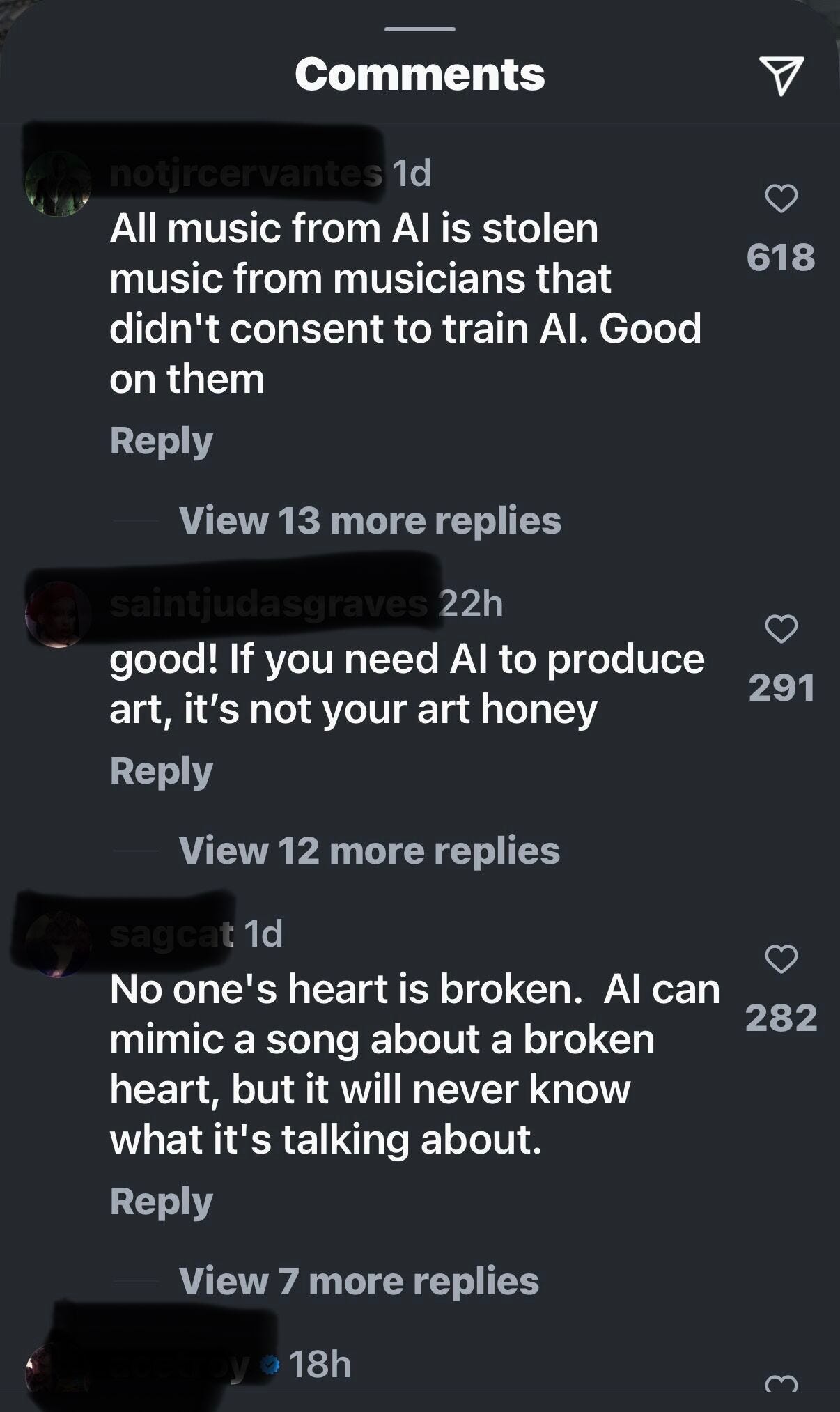
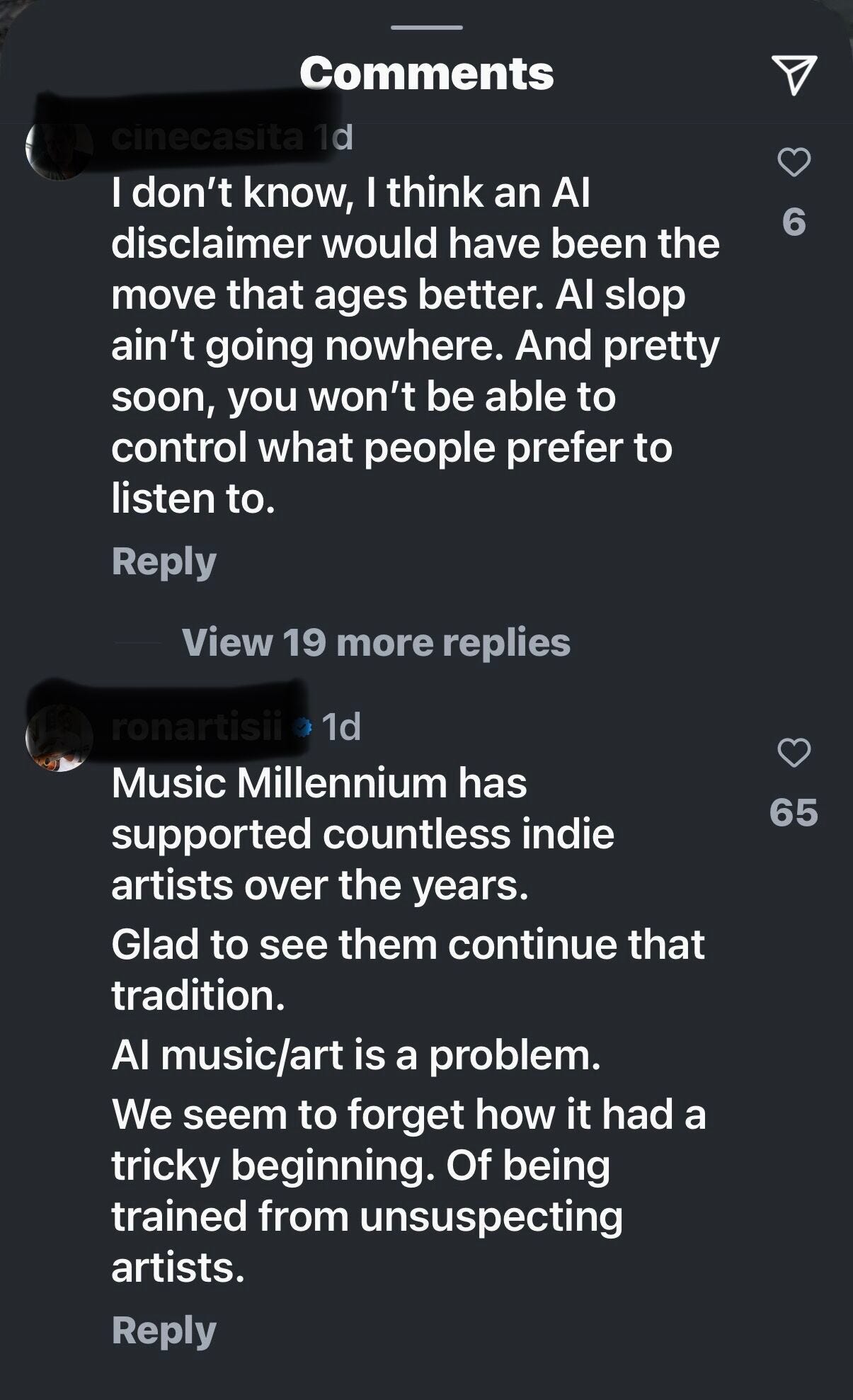
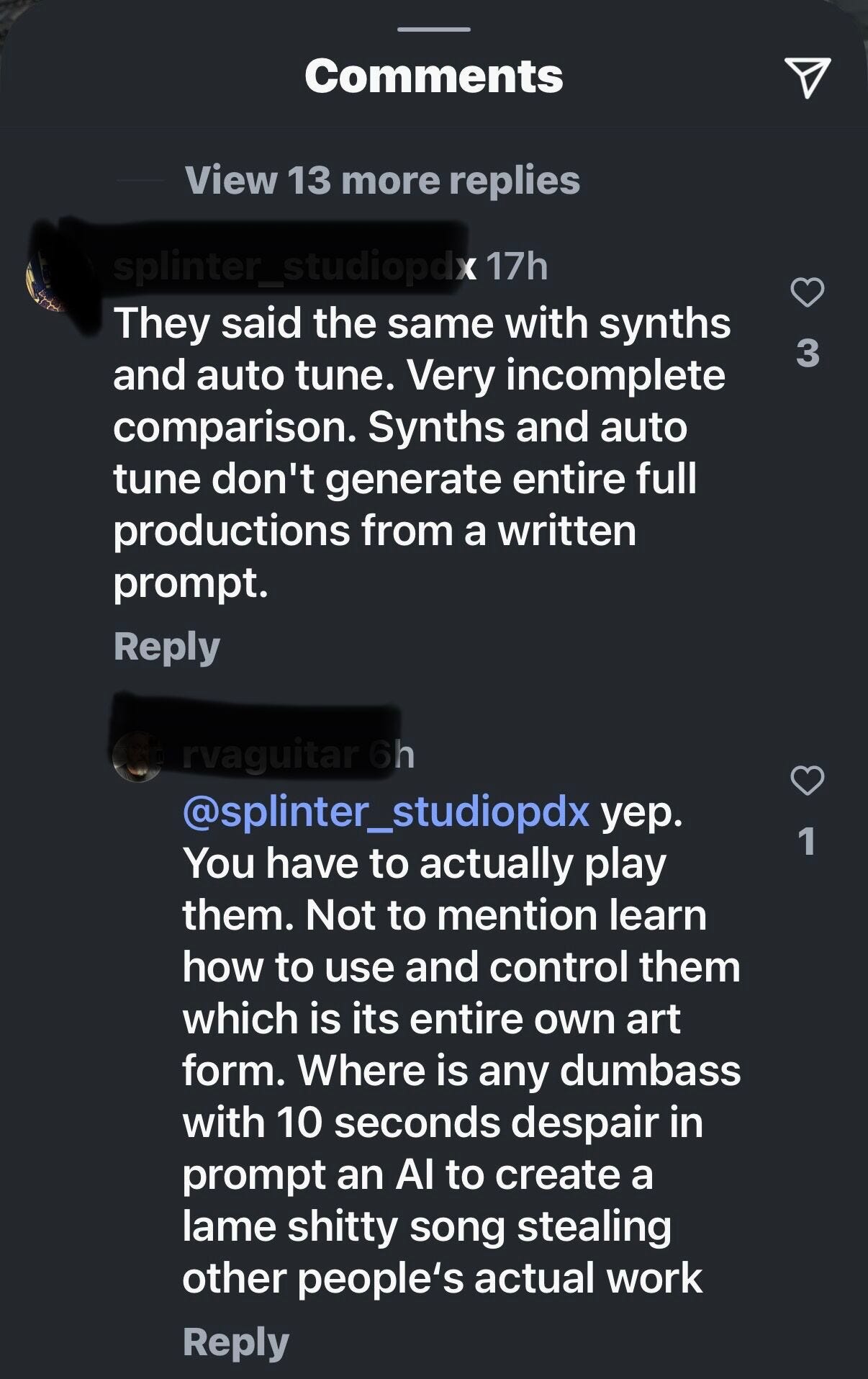
Zoom out and the comments aren’t really about Brandon Carmody.
They are about something else entirely: ownership and legitimacy, identity and who gets to call themselves an artist and who doesn’t.
The speed at which people arrived at their conclusions was almost more telling than the conclusions themselves, as if there’s a growing urgency to define the boundaries before they disappear altogether.
I understand the instinct.
When the ground starts to shift, when it feels like everything is changing all at once, people look for something solid to stand on, something that tells them they’re still on the right side of whatever line they believe matters.
Music has always had those lines. So has writing. So has art in general.
They’ve just never been this… fluid.
In my book, I write about using AI tools to bring my lyrics to life, and I ask a question that I haven’t been able to neatly answer, even after spending a lot of time sitting with it.
Does this make me a musician now?
A real question that lands a little differently depending on the day.
I can write lyrics. I’ve always been able to do that.
What I couldn’t do, at least not without years of practice and a completely different set of skills, was turn those lyrics into songs I could actually hear.
Until now.
Not by picking up a guitar or sitting at a piano, but by working with a system that translates what’s in my head into something audible, something structured, something that resembles the music I’ve spent my whole life listening to.
The first few times it happened, I wasn’t thinking about definitions or labels.
I was thinking about how strange and exciting it felt to hear my own words come back to me in a form I had never been able to create on my own.
There was a moment recently where that experience took on a different weight.
I was moving through a heartbreak that didn’t have a clean ending, the kind that lingers longer than you expect it to, the kind that doesn’t respond to logic or distraction or any of the usual strategies we reach for when we want to feel better faster.
I had pages of writing. Fragments. Half-finished thoughts.
And then I started turning them into songs.
Not to prove anything or become the next big thing on the streaming platforms.
Just to hear what I was actually feeling.
There’s something that happens when your own words come back to you through melody and rhythm, something that shifts them out of your head and into your body, something that makes them harder to avoid and, at the same time, easier to move through. (It’s one of the reasons why Taylor Swift is a gazillionaire.)
I found myself listening to those songs late at night, not evaluating them, not wondering if they qualified as anything other than what they were, which was an honest expression of something I had lived through.
It helped make a difficult experience feel less stuck inside me.
That matters.
It matters more than whether someone in a comment section thinks the tool I used disqualifies the outcome.
It matters more than whether a record store decides to host a listening party or cave to their constituents.
It matters more than whether someone with a strong opinion decides that what I made doesn’t meet their criteria for art.
None of those people were in the room when I wrote those words. None of them were there when I put headphones on and heard them sung for the first time. None of them get to define what that experience was or what it did for me.
There’s another layer to this that came up a lot in the comments.
The question of how these tools were trained.
Whose work was used? What was scraped? What was taken without permission?
People are not staying silent about this, and they shouldn’t.
There are real artists behind the data. Real bodies of work that didn’t opt in to becoming part of a system that can now generate something adjacent to what they spent years developing.
That’s not a small detail.
At the same time, most of what I saw in the comments wasn’t really a conversation. Most comments aren’t about conversation.
It was more like people stating their position and reinforcing it, which makes sense given how charged the topic is, but it doesn’t leave a lot of room for what I think many people are actually experiencing underneath it.
Which is something closer to conflict. In some cases, despair.
I feel that conflict.
I can care about how these systems were trained, and question the ethics of it, and still find myself using the tools.
Something meaningful came out of that process for me when I turned my lyrics into songs. I can also sit with the fact that the system itself raises questions I don’t have clean answers to.
Those two things don’t cancel each other out. They sit next to each other.
And they’re probably going to for a while.
Which brings me back to the reaction around Brandon Carmody.
It’s easy to look at a situation like that and reduce it to a simple narrative about protecting artists or pushing back against something new.
It’s harder to sit with the reality that we’re in a moment where the definitions themselves are in flux, and where the tools available to create are expanding faster than the language we have to describe what we’re doing with them.
Some people will lean into that. Some will resist it. Most will move between those positions depending on what’s at stake for them.
Meanwhile, the work continues.
People are still writing songs. Some with instruments. Some with software. Some with systems that didn’t exist a few years ago.
And some of those songs are doing exactly what songs have always done, which is help people process something they couldn’t quite access any other way.
That part doesn’t disappear just because the method changes.
It just gets harder to see if you’re only looking at the tool.
If this stirred something for you, I’m thinking about hosting a small live session where I walk through how I’ve been doing what I write about in this piece.
Not as a performance or a class; more like a guided experiment.
If you’d want to be part of it, you can raise your hand here.